
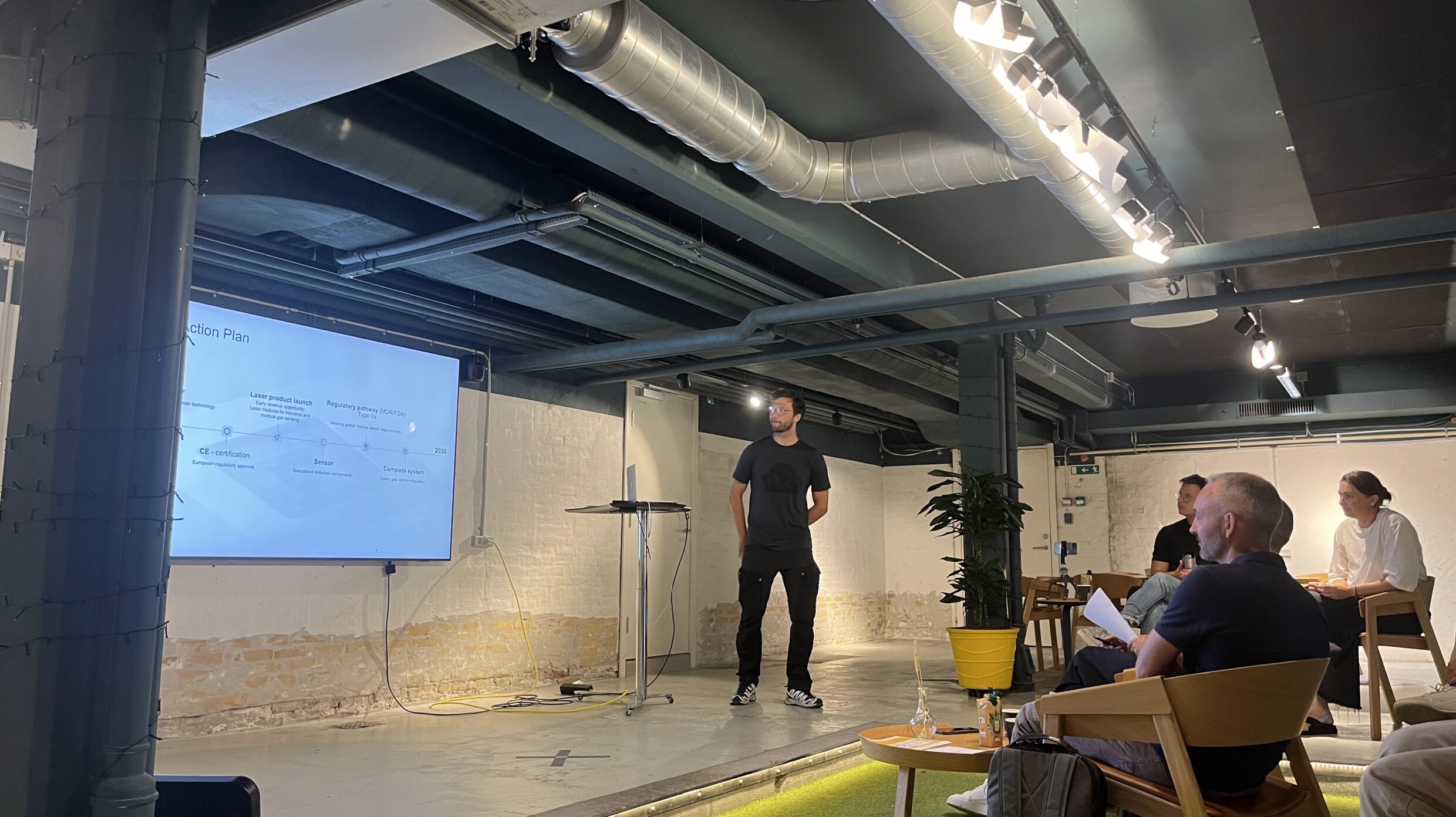
Pitch Week marks the end of the masterclass and the programme’s commercial training. For many participants, it is the hardest week – but also the most popular.
Researchers are trained to explain, while investors want to believe. Bridging that gap can be difficult, but it is not impossible.
It begins with boiling everything down to one clear core message. One sentence that makes people immediately understand who the solution creates value for – and why it matters to society.
That sentence is the foundation. And it is a lesson Lene Munk from COBLER learned through intensive, hands-on work during Spin-outs Denmark’s Pitch Week.
“You want to tell the audience everything about the existing problem and the solution you have created. But you must boil it down to the essentials. That’s difficult,” explains Lene Munk.
While Pitch Week was not her first attempt at distilling her research into a presentation simple enough for any layperson to understand, she has learned how practice makes perfect.
“I still had a lot of things I could change, and the intensity of Pitch Week makes you dig deeper. Because you receive feedback immediately after your pitch, it remains fresh in people’s minds, allowing them to point out exactly what needs to change,” Lene Munk points out about Pitch Week – the closest thing the programme has to an exam.
The Art Of Presenting
During the year-long Spin-outs Denmark programme, all postdocs take part in four masterclasses and a dedicated Pitch Week. The latter is a week in which the cohort learns how to showcase their solution to investors and potential customers, demonstrating why it is worth investing in.
“It’s a really tough week, but it’s also the week that participants enjoy the most,” explains Vegar Lein Ausrød, head of Toolbox at Kitchen, the Aarhus University incubator for entrepreneurs.
This is where the programme’s participants are taught the difficult art of pitching.
“Researchers often come in with the idea that they have found a gap in the theory in their field. That’s where they feel comfortable, and that’s where they want to stay. So, it’s not easy to identify who actually has a problem that fits your solution,” he says.
Each participant is given a template to work from, which makes it clear what data they still need to collect.
“We use the template throughout the masterclass, so if they do the work relevant to each topic, they will have done what is needed to deliver a strong pitch,” explains Vegar Lein Ausrød.
“A pitch is not about being an artist putting on a show. It’s about telling a credible, coherent story that communicates what you want, with the research underpinning it as a solid foundation – without foregrounding it too much,” he says.
What to Stick With
Pitch Week begins on a Thursday, when the cohort is divided into smaller groups, each working with dedicated pitch trainers. They spend the first week practising, then meet again the following Thursday to fine‑tune their presentations before delivering a concluding pitch to a panel on Friday.
During the process, the future entrepreneurs must make many choices about how to present their idea, technology and business – and therefore also what to leave out.
“The way you talk about your research is very different in this setting, because you need to present it as something you want to sell commercially,” explains Lene Munk of COBLER.
“You must be prepared for your presentation to be torn apart during Pitch Week and put back together in a new way. But the trainers will tell you that it’s not about you as a person, but about improving the project,” says the researcher, who focused on identifying the target audience for her pitch.
A lot has happened with the development of COBLER since the project left Spin-outs Denmark, and Lene Munk has since received further feedback from, among others, Innovation Fund Denmark.
“Pitch Week has definitely made my pitch much sharper and prompted me to think more clearly about what matters most when you have just 10‒15 minutes with investors, who often have a very different perspective from researchers,” she says.
The sharper pitch means that COBLER has entered 2026 with just over €0.4 million in soft funding, alongside two grants.
“With that level of funding, we expect to be ready to test our technology on women by the end of 2026 and to spin-out in 2027,” she says.
HOW TO MAKE YOUR PITCH WORK FOR YOU
It’s a storytelling exercise: You pitch to spark curiosity, to start a conversation.
Make the audience feel: ‘I need to know more’. A pitch is not about technology.
Know your audience: Be inclusive – avoid domain-specific abbreviations. Help us to understand the value you create for your users.
Focus: Use very little text. Focus on the main message of each slide. You’re the story. You’re in charge.
Keep it simple: Keep a clear, coherent and consistent narrative.
Remember: Preparation and practice make the master.
Kilde: Kitchen
Spin-outs Denmark is a unique programme that invests in researchers who create more impact by starting research-based companies.