

It can be difficult for a new research-based spin-out to secure its first paying customers, but that’s not always because of the product or solution. More often, it comes down to trust. That was exactly the challenge Gajraj Kuldeep faced.
2025 was a demanding and defining year for Gajraj Kuldeep.
After establishing Byte2Bit – a spin-out from Aarhus University – he faced a familiar challenge: despite strong technology, the company still needed to prove that customers could trust a young company with business-critical data.
“I was asking myself: where is this going?” Gajraj says, looking back at the end of last year.
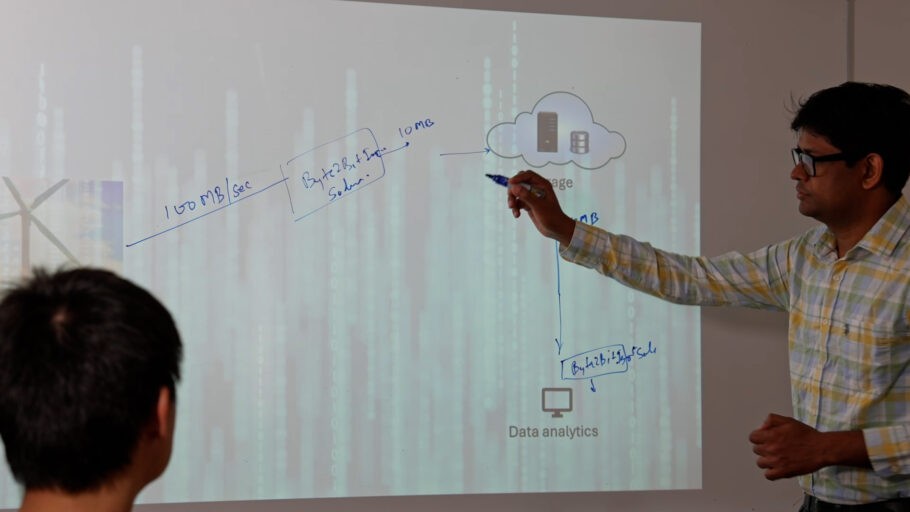
Byte2Bit is a compression technology that helps organizations optimize data storage and transmission, significantly reducing data size while maintaining data integrity. The technology offers up to 60 percent storage reduction.
“Finding problems and solutions is easy. Getting someone to buy the product – that’s the difficult part,” he says.

The importance of trust
In December, things finally started to turn around for Gajraj, who was part of Spin-outs Denmark’s second cohort back in 2023.
He was approached by a potential client, but the opportunity quickly revealed the real challenge: as a young spin-out, customers simply didn’t trust that the company would still be around in the long term. And when you are working with companies’ data, that problem becomes real.
“They told me, ‘We can’t take the risk. If you go out of business, we won’t have support,” he recalls, adding:
“You don’t put your money in a random bank. You need a bank you trust – it’s the same here.”
However, during that conversation, Gajraj learned something important. The client was working with massive amounts of weather data – at petabyte scale – and that gave him an idea.
“I reached out to InCommodities, presenting my solution as a way to compress and reduce their data – and therefore their costs – by up to 60%,” he explains.
Customers and investors
That approach worked, and the Aarhus company became Byte2Bit first customer.
InCommodities is a global technology company, specializing in energy trading and renewables asset management, and Byte2Bit helps them reduce the size of large numerical datasets used in energy and weather-related workflows.
“It seems like once you get one good customer, they act as strong references. Once well-known companies use your product, it becomes much easier to open doors and get meetings with others. I now have three customers,” Gajraj says.
The success also means, that Byte2Bit now has eight employees – most of them working part time – and is closing in on a deal with an investor.
And as with the customers, getting investors is not just about scaling: They are key to building trust, because having multiple years of funding is crucial. But it must be the right match.
“We have also learned that investor trust has to go both ways. Funding is important, but so is finding the right long-term partner who understands the company, the technology, and the market we are building for,” says Gajraj.
Now, he is close to securing a deal with a new investor. So, while Byte2Bit has already taken its first steps, the next phase will depend on turning that early trust into long-term relationships and continued growth.
About Byte2Bit
Byte2Bit was established as a company in 2025 and delivers lossless compression for Weather, Financial, Geospatial, & Scientific Data
The solution can cut storage up to 60% across weather models, Earth observation, orthophotos, and multidimensional raster data, all with zero data loss
Byte2Bit helps reduce the size of large numerical datasets used in energy and weather-related workflows. By compressing data without losing information, Byte2Bit can help lower storage and data transfer costs while keeping the original data fully recoverable.
Byte2Bit now has three paying customers: Vokalo, InCommodities, and Cordulus. The company is also in dialogue with investors as it prepares for the next stage of growth.
Spin-outs in this story


Spin-outs Denmark is a unique programme that invests in researchers who create more impact by starting research-based companies.